
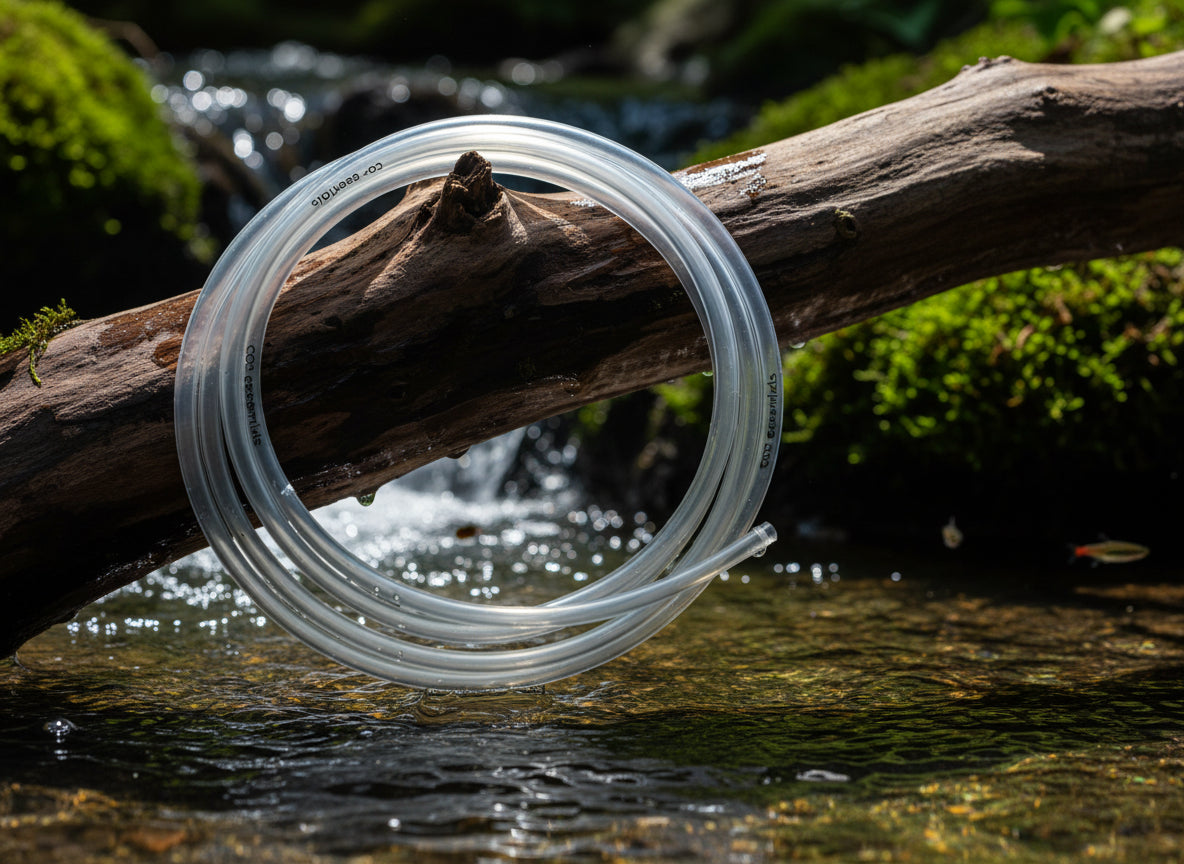
CO2-proof, or CO2-resistant, means a part that pressurised carbon dioxide cannot seep through, soften or corrode: the tubing, the check valve, the seals, the bubble counter and the diffuser. Aquarium air equipment is built for an air pump's gentle flow, not for gas held at cylinder pressure, which is why a planted tank needs a special CO2 system instead of borrowed airline parts.
What does CO2-proof or CO2-resistant actually mean?
The two words are used for the same idea, and neither of them is a certification. A CO2-proof part keeps carbon dioxide where you put it; a CO2-resistant part survives contact with it. In practice a seller means three things at once: the material does not let the gas diffuse through its wall, it does not swell or harden where the gas touches it, and it holds the working pressure a regulator delivers without stretching.
That matters because carbon dioxide does not behave like air. It is a small molecule that passes through soft rubbers far more readily, it dissolves into some plastics and the plasticisers in them, and in a pressurised system it arrives with force rather than drifting out of an air stone. A part can be perfectly good on an air line and still be the wrong part on a gas line.

Why ordinary airline tubing fails on a CO2 system
Standard silicone airline is the usual culprit. Silicone is soft, cheap and easy to fit, and it is also noticeably permeable to carbon dioxide: gas escapes through the wall along the whole run. The bubble counter still counts bubbles, so nothing looks wrong, but fewer of them reach the water. People then chase the problem by turning the needle valve up, which empties the cylinder faster and still does not raise the level in the tank.
The second failure is mechanical. Under working pressure a soft hose balloons, then creeps off a barb or splits at a bend, usually at night when nobody is watching. CO2-resistant tubing is firmer, which makes it slightly harder to push on and much harder to blow off. Clamp or tie the joints anyway; a gas line is not a place to rely on friction alone.
- A high bubble count while the drop checker stays blue
- A cylinder that empties sooner each time, with no change in the tank
- A hose end gone soft, shiny or slightly swollen near the barb
- Tubing that keeps slipping off the diffuser or the bubble counter
Which parts of a CO2 system have to be CO2-resistant
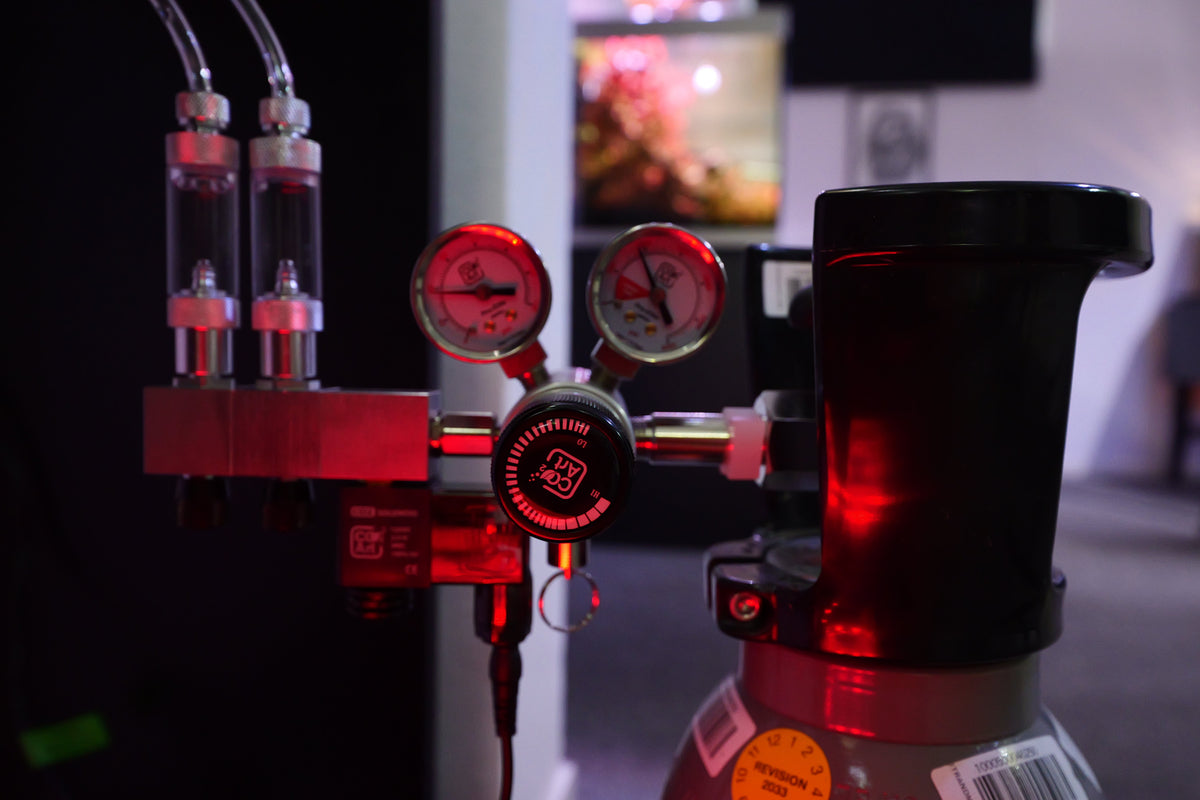
Follow the gas from the cylinder to the water and ask what it touches on the way. Everything on that path is a candidate: the regulator's seals, the washer at the cylinder connection, the solenoid, the bubble counter, the tubing, the check valve and finally the diffuser. The drop checker sits outside the path, but it is the instrument that tells you whether the path is doing its job.
The check valve protects everything upstream of it
A check valve stops tank water travelling back up the line when the system switches off and the pressure falls. Made of the wrong rubber, it stiffens, stops seating, and water reaches the solenoid or the regulator body. That repair costs far more than the valve, so this is the part to buy properly and to replace the moment it sticks or hesitates. Ours is a precision CO2 check valve built for a gas line rather than an air line.
Seals, washers and O-rings
Every joint is a potential leak, and the small parts are the ones people reuse without thinking. The washer between the regulator and the cylinder is designed to crush once; a tired one weeps gas quietly until the cylinder is empty. Fit a fresh washer at every cylinder change, keep the spare O-rings that came with your diffuser, and do not improvise with plumbing tape on a cylinder thread.
| Part of the system | What CO2 does to the wrong part | What to look for |
|---|---|---|
| Tubing | Gas seeps through soft silicone along the whole run, so bubbles are counted but never arrive | Tubing sold as CO2-proof or CO2-resistant |
| Check valve | A stiffened seal stops seating and tank water travels back toward the regulator | A valve made for the gas line, replaced as soon as it sticks |
| Seals, washers, O-rings | The wrong rubber swells or hardens and the joint weeps quietly | The washer the regulator's maker specifies, renewed at every cylinder change |
| Bubble counter | Low-grade plastic crazes and the joint begins to leak | A counter made for CO2, with its own seal and a firm barb |
| Diffuser | Weak ceramic or glue gives way, or the unit passes large bubbles | A diffuser rated for working pressure, inline or in-tank |
| Regulator and solenoid | Water drawn back up the line reaches the valve and it fails | A check valve upstream and a regulator built for CO2 cylinders |

Is a special CO2 system different from aquarium air equipment?
Yes, and the difference starts at the regulator. A CO2 regulator steps cylinder pressure down to a working pressure the rest of the kit can take, and a dual-stage design holds that output steady as the cylinder empties instead of dumping the last of it into the tank; that is the job of a dual-stage regulator with an integrated solenoid.
The diffuser is the other half of the answer. An air stone breaks air into bubbles you can see; a CO2 diffuser has to push gas through a fine ceramic or a reactor body so that it dissolves before it reaches the surface, and it needs working pressure behind it to do so, around at least 30 PSI on most ceramic discs. A diffuser meant for an air line simply weeps large bubbles, and the plants see very little of the gas.
How to check whether your CO2 system is CO2-proof
Start with a leak test. With the system running, brush soapy water over the cylinder connection, the regulator joints, every barb and the check valve, and watch for a film that grows. Then close the needle valve, note where the working pressure sits, and leave it: a gauge that has fallen by morning with nothing open is telling you the system leaks.
Next, compare what you inject with what arrives. Count the bubbles at the counter, then look at the diffuser, which should produce a steady mist rather than occasional large bubbles. Let a drop checker settle for a few hours and read the colour: blue means too little gas is dissolving, green is the range planted tanks aim for, and yellow is too much.
A high bubble count beside a blue checker is the signature of a permeable or leaking line. So is a cylinder that needs refilling sooner than the last one while nothing about the tank has changed.
Choosing CO2-resistant parts without overbuying
You do not need the most expensive version of everything. What matters is that each part is made for pressurised CO2 and fits the one next to it: tubing sized to your barbs, a check valve rated for the gas, a diffuser matched to the way your tank is plumbed.
Where the gas goes in is a question of plumbing, not of quality. If you run an external filter, an inline atomizer sits on the outflow hose and keeps the glass clear. If your filter is internal, or you simply want to see what the system is doing, an in-tank diffuser is the simpler answer. Both are built for working pressure; neither will behave on an air line.
Buy the small parts as spares while you are there. A fresh washer, a second check valve and a length of CO2-resistant tubing cost little, and they turn a Sunday-evening failure into a short repair rather than a week with no injection at all.

Frequently asked questions
Is silicone airline tubing safe to use for CO2?
It will not harm anything in the tank, but it is permeable to carbon dioxide and soft under pressure, so gas is lost along the run and the hose can creep off its barb. Use tubing sold as CO2-proof or CO2-resistant for the gas line.
What does a CO2-resistant check valve actually protect?
Everything between the valve and the cylinder. When injection stops and pressure falls, tank water can travel back up the line toward the solenoid and the regulator. A valve built for the gas line seats reliably and keeps that water where it belongs.
Do I still need special tubing if the run is short?
A short run loses less gas, but the pressure problem does not change: soft tubing still swells and slips at the barb. Most people keep the run short and use CO2-resistant tubing anyway, because the tubing costs very little compared with a flooded regulator.
Can I reuse my air pump accessories on a CO2 system?
The valves, splitters and air stones are made for the gentle flow of a pump, not for gas delivered at working pressure, so they leak, split or pass large bubbles. The bubble counter, the check valve and the diffuser should all be made for CO2.
How do I know whether my CO2 system is leaking?
Brush soapy water over every joint and watch for a film that grows. Close the needle valve and see whether the pressure still holds in the morning. A cylinder that empties sooner each time, or a high bubble count beside a blue drop checker, points the same way.
If you would rather not assemble that chain part by part, start from our complete CO2 kits, where the regulator, the diffuser and the fittings are chosen to work with each other.
Udostępnij:
Reaktor CO2 — zalety i wady w akwarium roślinnym